
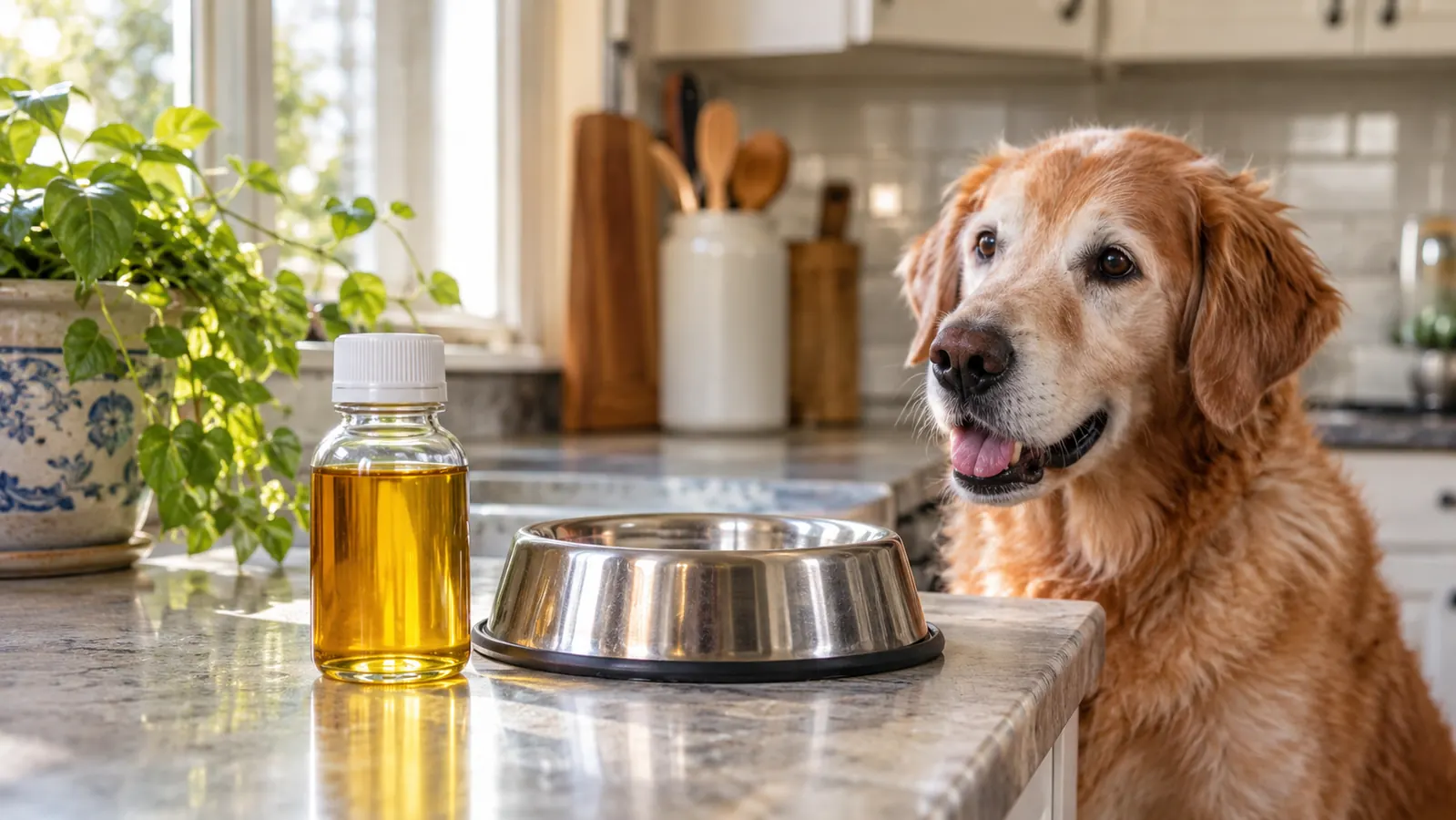
I am going to start with the thing I wish someone had told me before I bought Nordic Naturals Omega-3 Pet for Rudy: it is not a pill, it is not a chew, and it is not a once-a-day-and-forget-it kind of thing. It is a liquid fish oil in a two-ounce bottle, and you put it on his dinner every single day. That sounds like a small difference until you are the one standing over a 78-pound yellow Lab who has decided, on day three, that he is not sure about fish oil on his kibble. I am Marlene Hosack, I live in Ormond Beach with my husband Dale and our dog Rudy, and I have been giving Rudy this supplement for about a year. I kept a notebook the whole time. This is what I actually saw, what I would do differently, and what I would ask your vet before you spend a dime.
Rudy is ten, about 78 pounds, and he started getting stiff in his back hips around age eight. Slow to stand up after naps, hesitant on the three back-porch steps, and his coat went from glossy to dry and dusty-looking. Our vet suggested fish oil for his joints and his coat, so we added Nordic Naturals Omega-3 Pet to his dinner about a year ago. He was already on the Cosequin chewable tablets the vet recommended, so the fish oil went on top of that, not instead of it. I want to be clear about that, because no supplement I have tried has been a cure for anything. What I am looking for is comfort, easier get-ups, and a coat that stops looking like straw.
The Quick Verdict
A quality liquid fish oil that did help Rudy's coat and seemed to make his get-ups easier, but it is a daily routine, it smells like fish, and you should ask your vet about dosing before you buy.
Amazon Check Today's Price →The fish oil I kept buying for Rudy
After a year of daily use, this is the bottle I still reach for at dinner time. Talk to your vet first, then check today's price on Amazon.
Amazon Check Today's Price on Amazon →How I've Used It
The product is a liquid, two fluid ounces per bottle, and the active ingredient is omega-3 fatty acids in the triglyceride molecular form, which is the form naturally found in fish. I am not a chemist, so I will tell you what that meant in practice: our vet recommended this specific product, and the label lists coat, eyes, and heart as the specific uses, along with eye care, heart health, and immune support as benefits. We were using it for Rudy's joints and his dry coat, and that is what I watched. The bottle itself is small, about four inches tall and an inch and a half wide, and the whole thing weighs 4.8 ounces. It lives in the refrigerator door now, next to the butter, because it has to become part of the dinner ritual or it will get forgotten on a busy night. A chewable you can grab from the counter and hand over like a treat, but a bottle that lives in the fridge has to be part of the routine, and routine is the whole game with a liquid supplement.
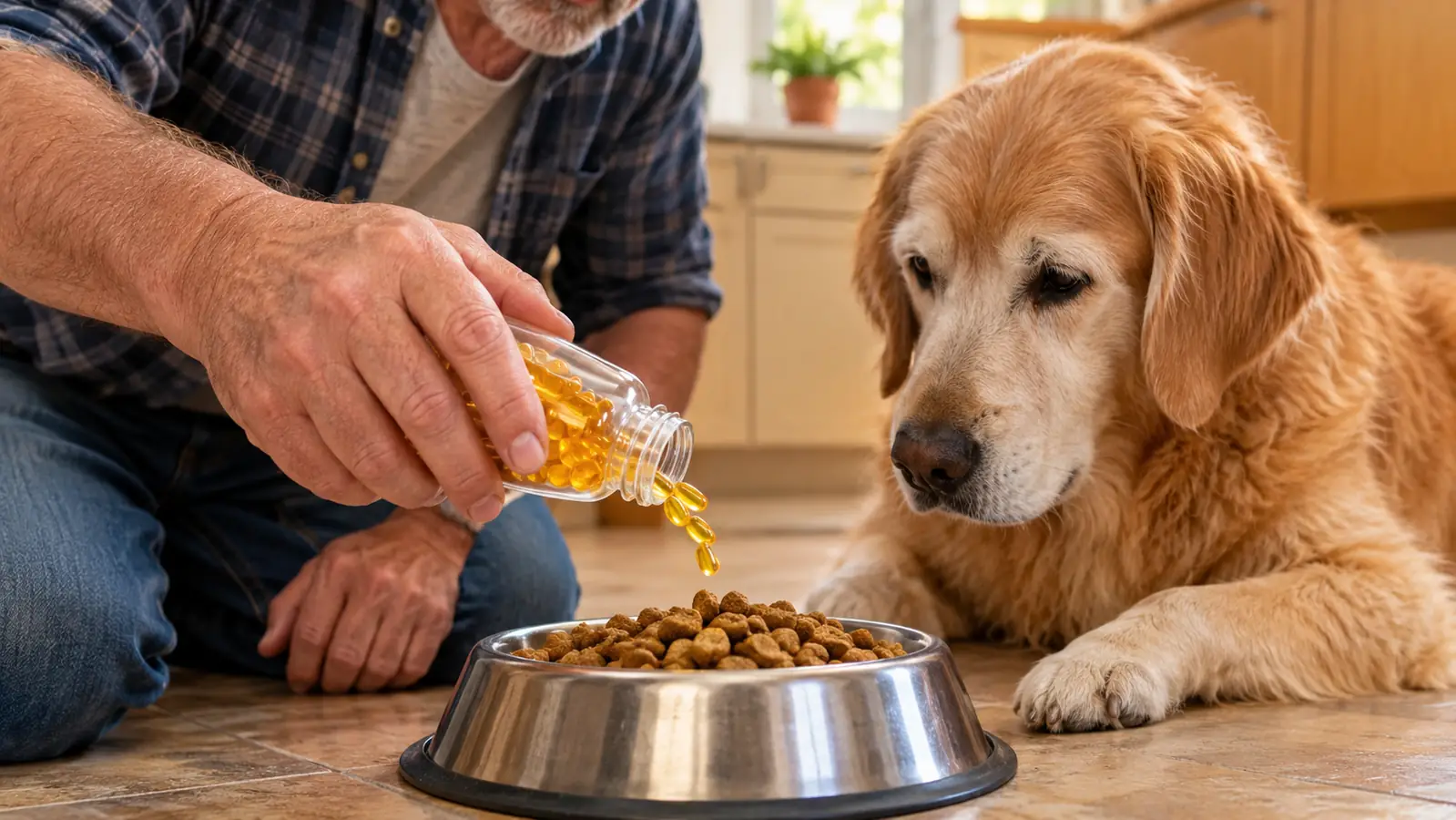
Dosing took some figuring out. The bottle is small, and when you start, you want to be careful not to overdo it. I started with less than the label suggested and worked up over the first week, because Rudy has a sensitive stomach and I did not want a mess on my tile floors. I pumped it straight onto his dinner and stirred it into the kibble. The first few nights he ate it fine. Around night three he gave me a look that said he was not impressed, so I started mixing it more thoroughly into the food, and that solved it. He has taken it every day since.
Our vet gave me a target for Rudy's weight, and I wrote it on the side of the bottle with a ballpoint pen. That is the detail I would never have figured out on my own: the right amount for a 78-pound dog is not something to guess. I also learned to stir the oil in before I put the bowl down, not after. The one night I poured it on top and then got distracted by the phone, Rudy licked the oil off the top of the kibble and left the rest of his dinner sitting there, which is not like him at all.
One thing nobody tells you: the bottle is two ounces, and that goes faster than you expect. At the dose our vet set for Rudy, a bottle lasted me about a month. I know that because I started writing the date on the bottle with a marker after the second order, just to see. Three weeks, give or take a couple of days. That means this is a recurring purchase, not a one-time buy, and you should plan for it that way. I set a reminder on my phone for the week I expected to run low, and I ordered the next bottle before the old one ran out. The last thing I wanted was to skip days and then have to convince Rudy all over again that fish oil on his dinner was a fine idea.
What I Actually Noticed (and What I Didn't)
I kept a notebook because I do not trust memory when it comes to supplements. Memory will tell you a product worked because you want it to work. A notebook shows you what actually changed and when. Here is what I wrote down.
The coat was the first thing. Rudy's coat had gone dry and dull, and after about four to six weeks of daily fish oil, it looked noticeably less dusty. It was not an overnight change, and I do not trust anything that promises that. It was a gradual, real improvement that my husband noticed on his own, which is the best kind of evidence, because Dale does not watch for these things. By the three-month mark, Rudy's coat had a softness to it that it had not had in over a year.
The hips were slower to show anything. Rudy still takes a moment to stand up after a nap, and he still pauses at the top of the back-porch steps on bad days. But the really stiff mornings, the ones where he would shuffle for the first few steps, those became less frequent. I would say it took a good six to eight weeks before I was willing to write that in my notebook, and even then I wrote it as 'seems better, could be the weather.' One cold morning last winter stands out. Rudy had been on the fish oil for about five months by then. It was the kind of damp morning that used to make him shuffle across the tile like an old man. He stood up from his bed, shook himself, and walked straight to the back door without the usual pause. I wrote in the margin: 'no hesitation today.' Was it the fish oil? The bed? The weather turning? I honestly cannot say. I do not want to overstate any of this. Fish oil is not going to undo years of wear on a big dog's hips. What it seemed to do was take the edge off.
I also have to be honest about the thing nobody tells you when you test a supplement on a real dog: we changed more than one thing that year. About two months after we started the fish oil, we swapped Rudy's flattened bed for an orthopedic memory foam one. A couple of months after that, we added a green-lipped mussel soft chew, again after clearing it with the vet. So when I say his mornings got easier, I cannot hand you a clean experiment. The coat improvement tracked most clearly with the fish oil, and at his yearly checkup the vet ran a hand over his back and said his coat felt better than it had the year before. That meant more to me than my own notebook, because the vet had no reason to flatter me. But the hips were probably helped by all of it working together. That is the truth about caring for an older dog: you do what the vet suggests, one thing at a time, and you take the win however it comes.
The Honest Downsides Nobody Puts in the Product Photos
Here is the part that is not in the listing. First, it smells like fish. Not a little. The label says unflavored, and that is technically true, but do not let the word fool you. It is unflavored the way the ocean is unflavored. Every time I open the bottle, the kitchen smells like the dock for a few minutes. The smell lingers on the spoon I use to stir it into his dinner, so I have a dedicated spoon now, and it lives in a mug on the counter, and even the mug smells like fish. If you have a sensitive nose, this matters more than you think it will.
Second, it is a liquid, and liquids are messier than chews. Rudy is a dog who eats like he has never been fed, so the first time I put the oil on top of his kibble, half of it ended up on the bowl and the floor. Mixing it in thoroughly helped, and I learned to put the bowl down on the floor before I poured, so the drips landed in the bowl instead of on the tile. I still wipe the bowl after dinner. On tile floors, a few drops of fish oil are slippery, and I have already got one older dog navigating slippery floors. I do not need to add to it.
Third, the bottle is small. Two fluid ounces sounds like almost nothing when you are standing in the store, and it is. The honest math is the cost per dose, not the cost per bottle, and that only becomes obvious after you have reordered a few times. I learned that the hard way the week I misjudged my reorder timing and we went three days without it. Rudy did not seem to miss it, which told me something useful: this is not a supplement that shows withdrawal when you stop. But it also told me that a three-day gap is exactly how you convince yourself a supplement is not working. If you are not going to keep up a daily routine, this is not the product for you, and it is better to know that before you buy.
Fourth, and this is the one I really want you to hear: the brand's own listing says this product is for small dog breeds, and it is labeled for cats and dogs. Rudy is a 78-pound Labrador. I cleared the dose with our vet before we started, and our vet gave us the amount that was right for Rudy's size. I would never have guessed that on my own. If you have a big dog, do not just pour the label dose and hope. Ask your vet. That is not me being cautious for fun. That is me telling you the thing I wish someone had told me.
What I Liked
- Rudy's coat looked noticeably less dry and dusty after about four to six weeks, and my husband noticed it without me pointing it out
- Omega-3 in the triglyceride form, the form naturally found in fish, with no artificial colors, flavors, or preservatives
- Easy to add to dinner once the routine is set, and Rudy takes it fine mixed into his kibble
- Our vet approved it, and it sat alongside his Cosequin chewable without any stomach upset
Where It Falls Short
- It is a liquid, not a chew, so it is messier and has to be stirred in well
- It smells like fish, and the smell lingers on the spoon and in the kitchen
- The two-ounce bottle goes fast at a large dog's dose, so it is a recurring purchase
- The label is written for small dogs, so a big dog's dose has to come from your vet
The coat was the first thing I noticed, after about four to six weeks. The hips were slower, but the really stiff mornings became less frequent.

Who This Is For
Nordic Naturals Omega-3 Pet is for someone who is already giving their dog a daily meal and does not mind adding one more step to it. It is for someone whose dog eats enthusiastically, because the oil mixes best into food. It is for someone who wants a fish oil in the triglyceride form, made with non-GMO, gluten-free and dairy-free ingredients, with no artificial colors, flavors or preservatives, and who is willing to pay a little more for that. And it is for someone who has talked to their vet about whether their dog actually needs it, because the answer is not always yes.
It is also for someone with a dog like Rudy: a senior dog with a dry coat and some stiffness, where the vet has said fish oil is worth trying. If that is your situation, this is a legitimate product to consider. Just go in with your eyes open about the routine.
Who Should Skip It
If your dog is a picky eater, skip it. You will spend every dinner negotiating with a dog who has decided his kibble is ruined, and you will both be miserable. If you travel a lot or your dog's meals are not on a consistent schedule, skip it, because this supplement works on daily consistency, not on occasional good intentions. If your dog has a fish allergy, obviously skip it. The allergen information on the bottle says fish, so that is not a detail to overlook.
And if you are looking for a chewable that you can hand over like a treat, skip this one. Nordic Naturals makes other products, but this particular one is a liquid, and no amount of wishing will turn it into a pill. I give Rudy his Cosequin chewable as a treat and he loves it. The fish oil is a different kind of routine, and I would not pretend otherwise.
I would also say this: if you are hoping for a supplement to fix a limp or replace a vet visit, skip it. Fish oil is a nutrient, not a medicine. When Rudy had a stretch of really bad days last fall, I did not add more fish oil. I called our vet, who had me watch him for a week and adjust how much exercise he was getting. The fish oil stayed in his bowl because it was part of the plan, but it was never the whole plan. If your dog is suddenly worse, do not reach for a bigger dose of anything. Reach for the phone.
Still deciding? Ask your vet first, then compare today's price
A year in, I would buy it again for Rudy, but only because our vet helped us get the dose right. Check today's price on Amazon and see if it fits your routine.
Amazon Check Today's Price on Amazon →