
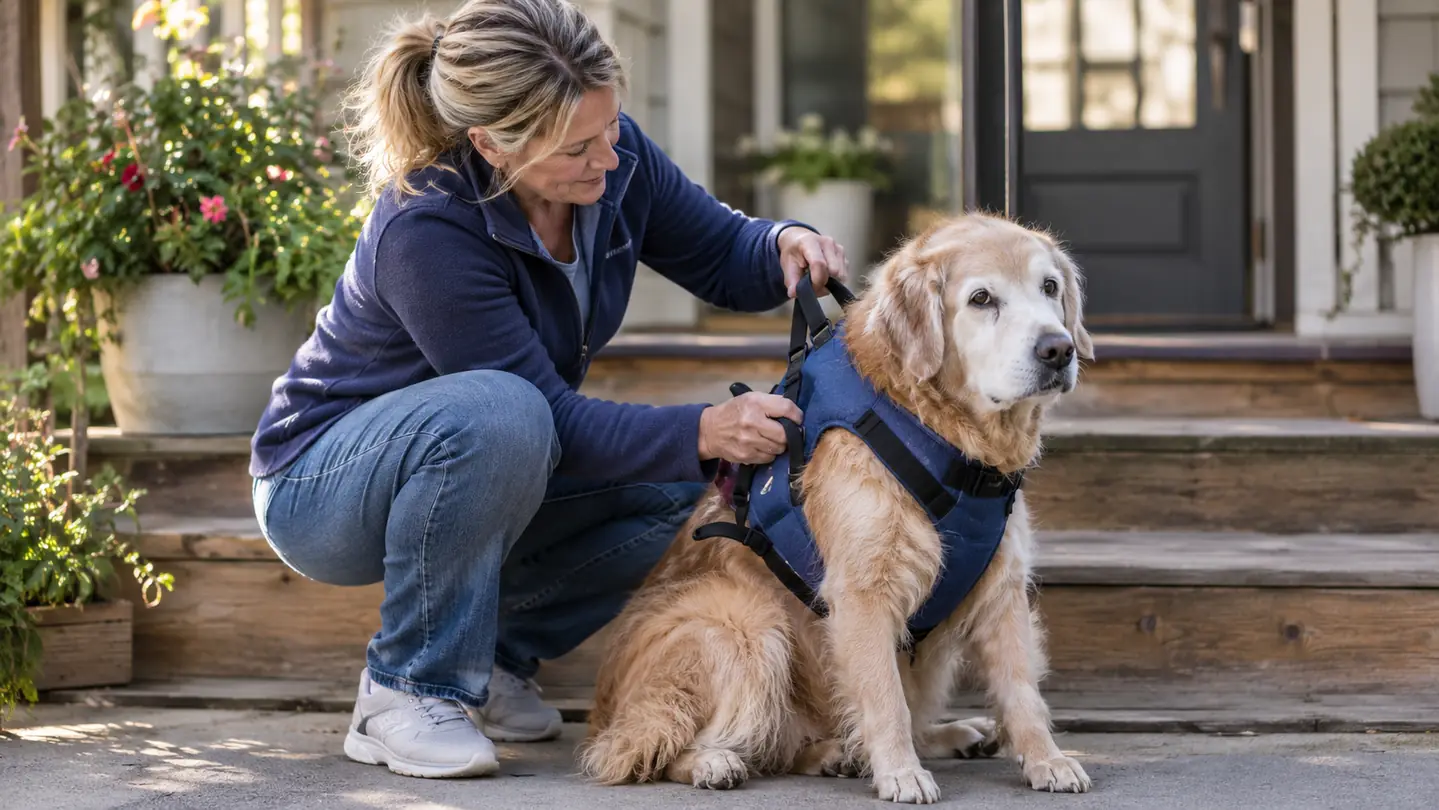
The morning Rudy stopped at the bottom of the three back-porch steps and just stood there, I knew we had crossed a line. He is a 10-year-old yellow Lab, about 78 pounds, and his back hips have been stiff for a couple of years now. Most days he manages fine. But on a damp morning, or after a long nap on the tile floor, those three steps might as well be a flight of stairs. He would look up at me, and I could see him thinking about it. That is a hard thing to watch.
I tried a few things before I bought the LOOBANI lift harness. I tried coaxing him with a treat at the top. I tried going slower. I even carried his back end once, which is how I learned that a 78-pound dog does not appreciate being scooped like a puppy. What I really needed was a way to take some weight off his hips for those ten seconds it takes to climb the steps, without pulling on his front legs or twisting his back. That is what a lift harness does, and I want to walk you through how we use ours, plus what to ask your vet before you start.
The harness that changed our porch-step mornings
The LOOBANI lift harness gives you a rear handle so you can take weight off your dog's hips for those few seconds that matter most. It is the one we reach for on Rudy's stiff days.
Amazon Check Today's Price on Amazon →What a Lift Harness Actually Does
A lift harness is not a wheelchair and it is not a full-body sling. It is a piece of nylon that wraps around your dog's belly and lower back, with handles that sit along the top. You hold the rear handle and lift gently as your dog moves. The idea is simple: you supply a little of the support, your dog supplies the rest. For Rudy, that little bit of lift is the difference between planting his front paws and stepping up, or standing at the bottom of the steps waiting for me to figure something out.
The LOOBANI harness is made for large dogs with weak rear legs, and the X-Large size fits Rudy's 78-pound frame with room to spare. It has a soft lining on the inside, which matters more than I expected. The first time I put it on him, I was worried he would hate it. He stood there, looked down at the nylon around his belly, and then looked at me like, is that it? He did not fight it. That is the whole ballgame with a senior dog. If the harness is not comfortable, he will not move, and none of this works.
One thing I want to be clear about: the harness does not do the work for him. It does not carry him up the steps. It gives me a way to help him without hurting either of us. He still climbs the steps himself. I just take enough weight off his hips to make the climb feel possible again. That distinction matters, because I have seen products that promise more than they can deliver. This one is a helper, not a cure, and it is very good at the job it is built for.
Before You Buy: What to Ask Your Vet
I am going to say this before anything else, because I wish someone had said it to me: talk to your vet before you buy a lift harness. Not because the harness is risky. Because the harness is a tool, and you want to make sure you are using the right tool for the right problem. Rudy's stiffness comes from his hips, which our vet confirmed with a hands-on exam. If your dog is suddenly struggling to climb stairs, that sudden change is worth a vet visit on its own, before you order anything.
Ask your vet a few specific questions. Is the weakness in the rear legs, or is something else going on? Are there joints that should not be lifted or twisted? Is there a weight limit you should keep in mind? Our vet also reminded me that a harness is not a substitute for a proper mobility plan. For Rudy, that plan includes the Cosequin chewable tablets he has been on for about two years, the omega-3 oil the vet suggested for his joints, and the orthopedic bed he sleeps on. The harness is one piece of that plan, not the whole plan.
If your vet gives you the green light, the next step is measuring your dog. The LOOBANI comes in sizes, and the size chart matters more than the breed label. I measured Rudy around the widest part of his belly before I ordered, and the X-Large was the right call. A harness that is too loose will slide around when you need it most. A harness that is too tight will dig in and your dog will learn to hate it. Take the two minutes to measure. It saves a return and a frustrated dog.
Step 1: Put the Harness on Before You Need It
Do not wait until Rudy is standing at the bottom of the steps to figure out the harness. I learned this the hard way. The first time I tried to put it on him at the porch, he was already anxious about the steps, and the whole thing turned into a wrestling match. Now I put the harness on in the kitchen, where he is relaxed, about five minutes before we head outside. It takes ten seconds. He barely looks up from his breakfast.
The harness wraps around his belly and lower back, with the handles along the top. It closes with a drawstring, so I can adjust it to fit snugly without fiddling with buckles. Snug is the goal, not tight. I should be able to slide two fingers between the harness and his belly. When it fits right, the handles sit along his back where I can reach them without bending over too far, which my own back appreciates.
A note on timing: I only use the harness for specific moments, like the porch steps and the car. Rudy does not wear it all day. It is a helper for the hard parts, not a piece of clothing. That keeps him comfortable and keeps the harness from becoming one more thing he has to tolerate.
Step 2: Stand Beside Him, Not Behind Him
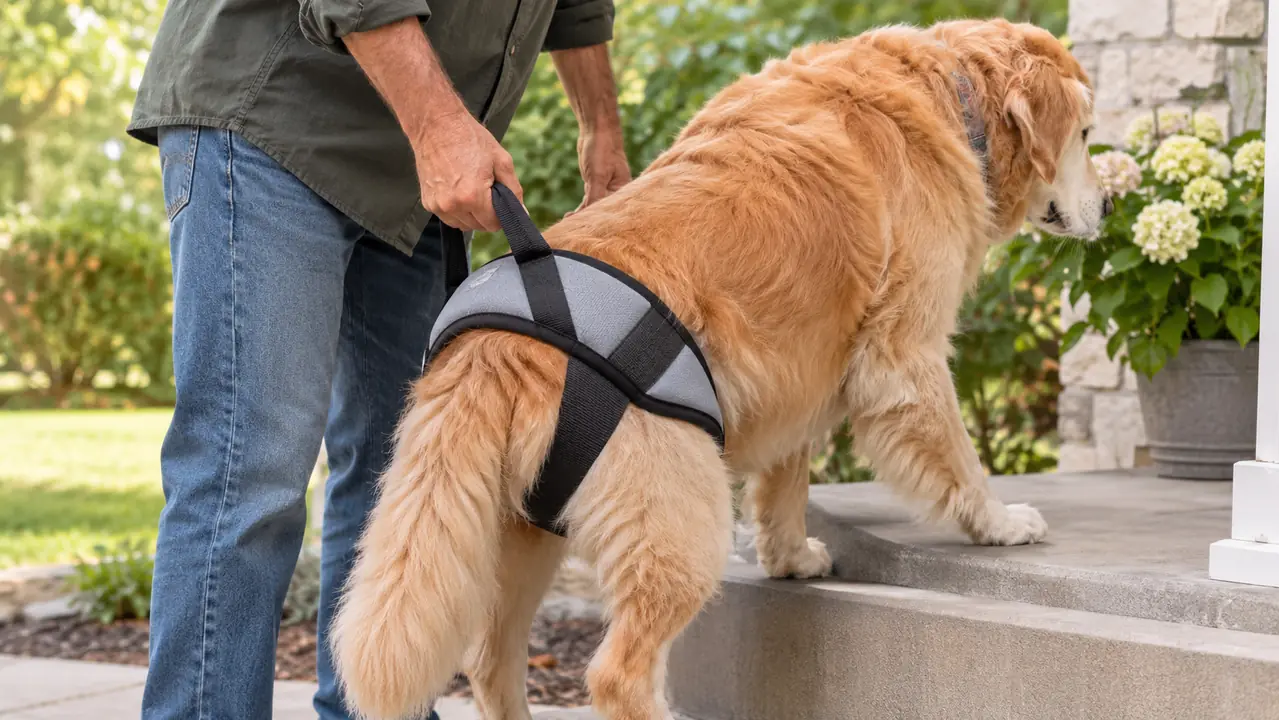
Position matters more than strength. When Rudy is ready to climb, I stand beside him, on his right side, facing the same direction he is facing. My left hand holds the rear handle, and my right hand is free to steady his shoulder if he needs it. Standing beside him means I am lifting up and slightly forward, which is the direction his body is already moving. If I stood behind him and pulled back, I would be fighting his movement instead of helping it.
The rear handle is the one that does the real work. When Rudy lifts a back leg to take a step, I lift gently on the handle, just enough to take some weight off that hip. It is not a hoist. It is a rhythm. Step, lift, step, lift. The first few times, I lifted too much and he looked confused. Then I lifted too little and it did not help. Within a week, we found the rhythm, and now it feels like we are dancing a very slow, very careful dance.
If your dog needs more support on the front end, you can hold the front handle instead, but I have never needed to with Rudy. His front legs are strong. It is the back end that needs the help, and the rear handle is exactly where that help belongs. Keep your own back straight and let your legs do the lifting. A 78-pound dog will teach you that lesson quickly if you ignore it.
Step 3: Take One Step at a Time
The three steps down to our yard are low and wide, which is lucky. But even on those, Rudy does best when we go one step at a time. I do not rush him. He plants both front paws on the first step, I lift gently on the rear handle, and his back legs follow. Then we pause. Then the next step. The whole process takes maybe twenty seconds for three steps. It used to take five seconds when he was eight. I do not miss the five seconds. I am just glad he can still make the climb.
Going down is actually harder for him than going up. Coming down, his weight shifts forward onto his front legs, and his back legs have to lower him from one step to the next. I use the rear handle the same way, lifting just enough to keep his hips from dropping too fast. It is a gentler version of the same rhythm: step, lift, step, lift. The harness gives me the control to make sure he never lands hard.
Some days he does not need the harness at all. Some days he walks past the steps like they are nothing. I let him decide. If he is moving well, I leave the harness in the kitchen. If he hesitates at the top of the steps, I go back for it. The harness is not a punishment and it is not a reminder of his age. It is just a tool that lives in the drawer for the days he needs it.
Step 4: Use It for the Car, Too
The porch steps are the daily challenge, but the car is the one that sneaks up on you. Rudy has always loved rides, and he still does. But getting into the back of our SUV became a two-person job on his stiff days. He would put his front paws on the seat, then stop, with his back legs still on the ground and no idea how to finish the climb. The LOOBANI harness fixes that the same way it fixes the steps. I stand beside him, lift gently on the rear handle, and he finishes the jump himself.
The same rhythm works for furniture, if your dog is allowed on the couch. I know a lot of people with senior dogs who have had to stop letting the dog on the bed because the dog cannot get down safely. The harness can help with that too, but I would check with your vet first, because getting off furniture is a different motion than climbing stairs and some dogs should not be doing it at all anymore.
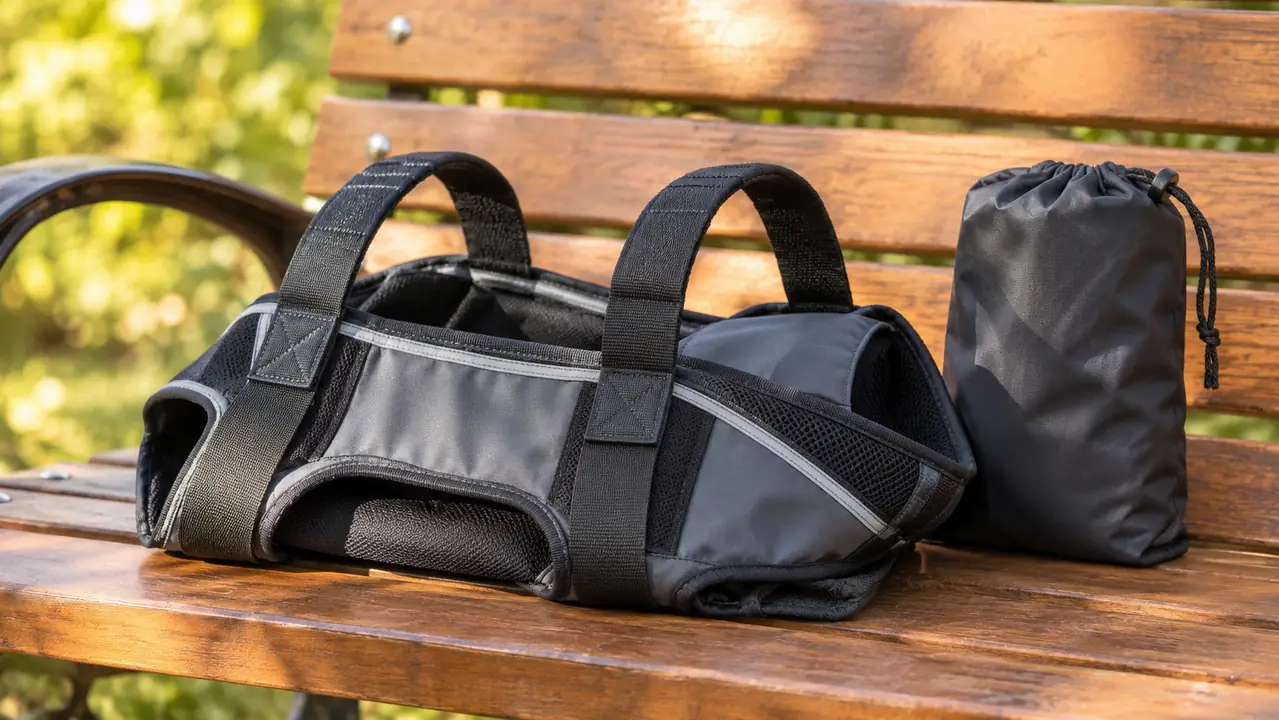
I keep the harness in the car, folded in its storage bag, and I keep a second one in the kitchen. The storage bag is a small thing, but it means the harness has a home and it does not end up tangled in the bottom of the laundry basket. After a muddy walk, I just toss it in the washing machine. The care instructions say machine wash, and I can confirm it comes out looking like new.
Step 5: Watch, Adjust, and Loop in Your Vet
The first week with the harness, I wrote everything down. I have kept a notebook on Rudy since he turned eight, and I know exactly what changed and when. With the harness, the change was not dramatic. It was the absence of the pause. The hesitation at the bottom of the steps got shorter. The look that said I am not sure I can do this got rarer. By the end of the first month, he was using the steps on his own on good days, and on bad days, the harness made the difference between going out and staying in.
That is the honest version of what a lift harness does. It does not cure arthritis. It does not rebuild muscle. It does not make a 10-year-old dog young again. What it does is buy you minutes. It buys you the morning walk. It buys you the ride to the park. It buys you the small, ordinary moments that make up a good life with an old dog. That is worth a lot.
And if you notice your dog getting worse, or the harness stopping its help, call your vet. I have called ours more than once. Rudy's mobility plan has changed over the years, and the harness is part of the current version. It may not be part of the next one. That is okay. The goal is not to hold onto any one tool. The goal is to keep him comfortable and moving for as long as we can.
What Else Helps
The harness is one piece of Rudy's mobility plan, but it is not the only piece, and I do not want you to think it is. He takes a Cosequin chewable tablet every day, the first thing our vet suggested when his hips started getting stiff at age eight. He has been on it about two years, and I noticed easier get-ups after roughly six weeks. We also added a soft chew with green-lipped mussel about eight months ago, after I read about it and cleared it with the vet, and a liquid fish oil on his dinner that the vet suggested for his joints and his coat. None of these are quick fixes. They are daily habits, and they work together.
I also replaced his old flat bed with an orthopedic memory foam bed about ten months ago. He had flattened the old one down to nothing, and getting up from a flat bed in the morning was the hardest part of his day. The new bed gives him a place to rest that does not fight his hips. If your dog is stiff in the mornings, look at where they sleep. A firm, supportive surface can make a surprising difference.
And the cheapest thing that helps is traction. Our house has tile floors, which are slick for an older dog. I put down runners in the hallway and a mat by the back door. Rudys feet do not slide out from under him anymore, and that alone has cut down on his hesitation. If your dog is slipping on hard floors, that is a problem you can fix today, without waiting for an order to arrive.
The harness does not carry him up the steps. It gives me a way to help him without hurting either of us, and that little bit of lift is the difference between going out and staying in.
Give your dog the few extra steps they still want to take
The LOOBANI lift harness is the tool we reach for on Rudy's stiff days, for the porch steps and the car. It folds into its storage bag, it washes in the machine, and it is there when your dog needs it.
Amazon Check Today's Price on Amazon →