
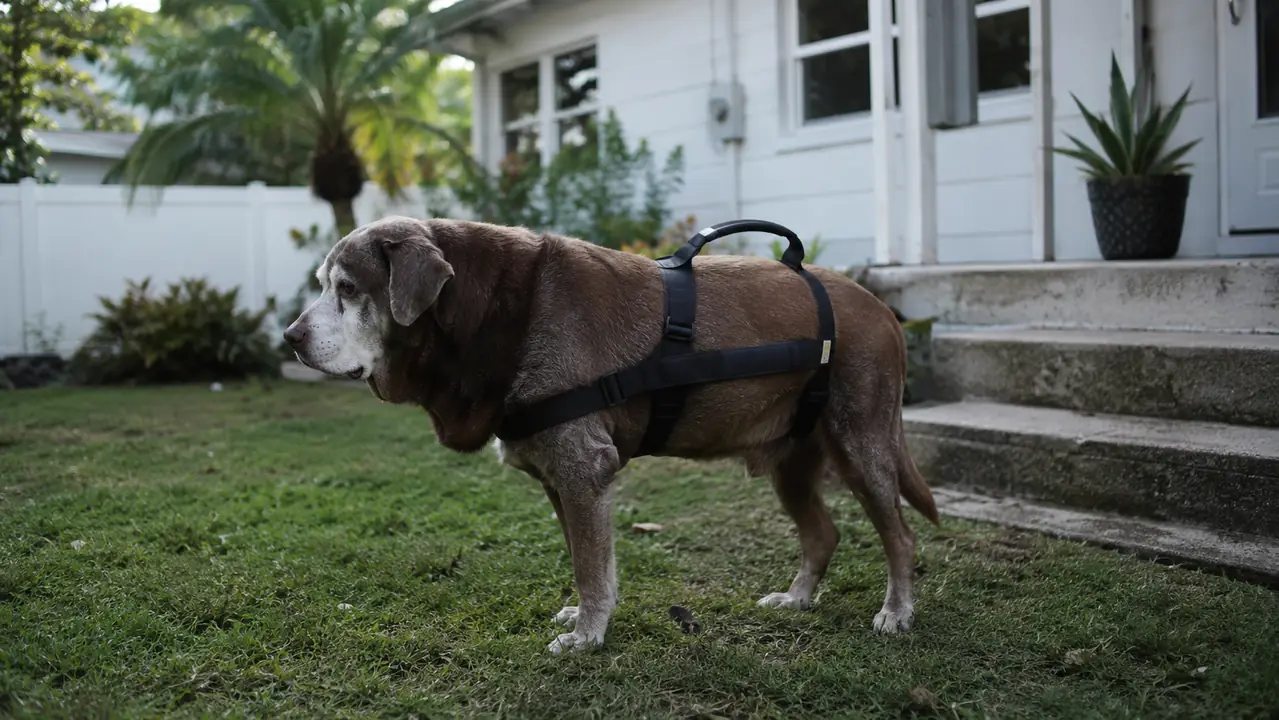
If you have a big dog who is suddenly hesitating at the bottom of the porch steps, you know the exact moment I mean. Rudy, our 10-year-old yellow Lab, weighs about 78 pounds, and around age eight he started getting stiff in his back hips. He could still manage the three steps down to the yard, but he would pause first, rock back on his haunches, and give me a look that said he was doing the math. I spent months trying to figure out whether we needed a ramp, a sling, a set of stairs, or just a better routine. What I landed on, after checking with our vet, was the LOOBANI dog lift harness for large dogs, and six months later I still reach for it almost every day.
This is not a story about a sudden fix. Rudy still has stiff hips and he still takes his joint supplement every morning, the same chewable our vet suggested when he was eight. The LOOBANI harness is a helper for specific moments: the back steps, the car door, the first few seconds after he stands up from a nap. It does one thing, it does it simply, and for us it has made those hard moments noticeably easier. Here is what I learned testing it over six months, what I would tell a friend, and the questions I would ask your vet before you buy one.
The Quick Verdict
A well-made rear support sling that takes real weight off a big dog's hips for stairs, car rides, and standing up. It will not fix the underlying stiffness, but as a daily helper for specific moments, it has earned its place by our back door.
Amazon Check Today's Price →The harness I keep by the back door for Rudy's bad-hip days
A simple nylon lift sling with a rear handle that takes some weight off a big dog's hindquarters for the porch steps, the car, and getting up after naps. No buckles to fight, no wearing it all day, just support exactly when your dog needs it.
Amazon Check Today's Price on Amazon →How I've Used It
I bought the LOOBANI about six months ago, on a Tuesday morning in late March, after Rudy could not quite get himself up the last porch step and I had to put my hand under his belly to help him finish. That works in a pinch, but it is hard on my back and it puts pressure in the wrong place. I asked our vet about a ramp and about a lift harness, and the vet said a rear support sling was worth trying for a dog who still had good strength in his front end but was losing power behind.
The harness itself is simple. It is a nylon sling with a drawstring closure, a soft lining, and a handle positioned over the dog's rear. The size we use is X-Large, which fits Rudy's 78-pound frame with room to spare. The whole thing weighs about 14.88 ounces, so it is not a heavy piece of gear to keep by the door, and it comes with a storage bag so I can fold it up and tuck it in the car. When the weather gets grubby, the care instructions say it is machine washable, and I have washed it several times without any problem.
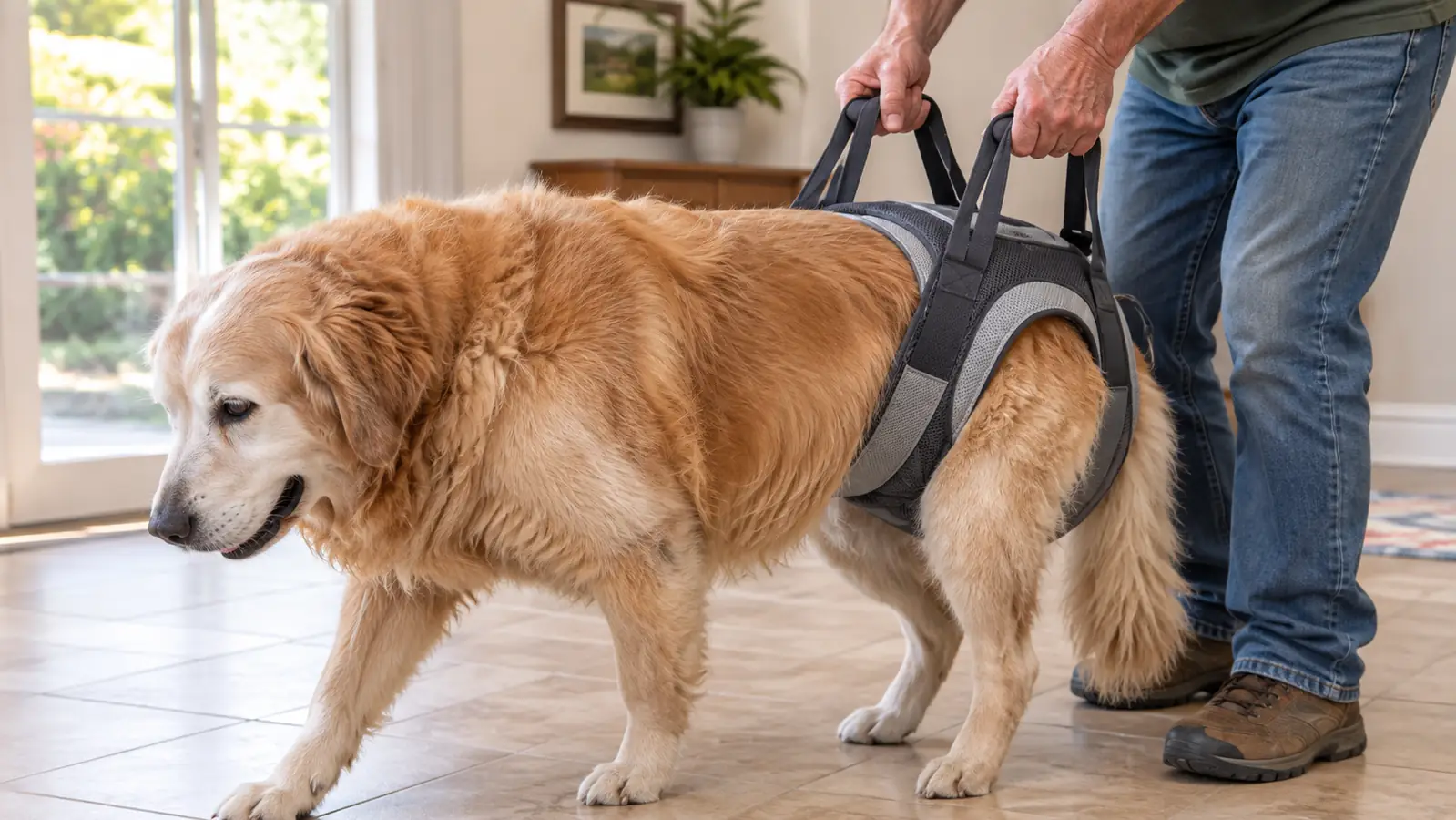
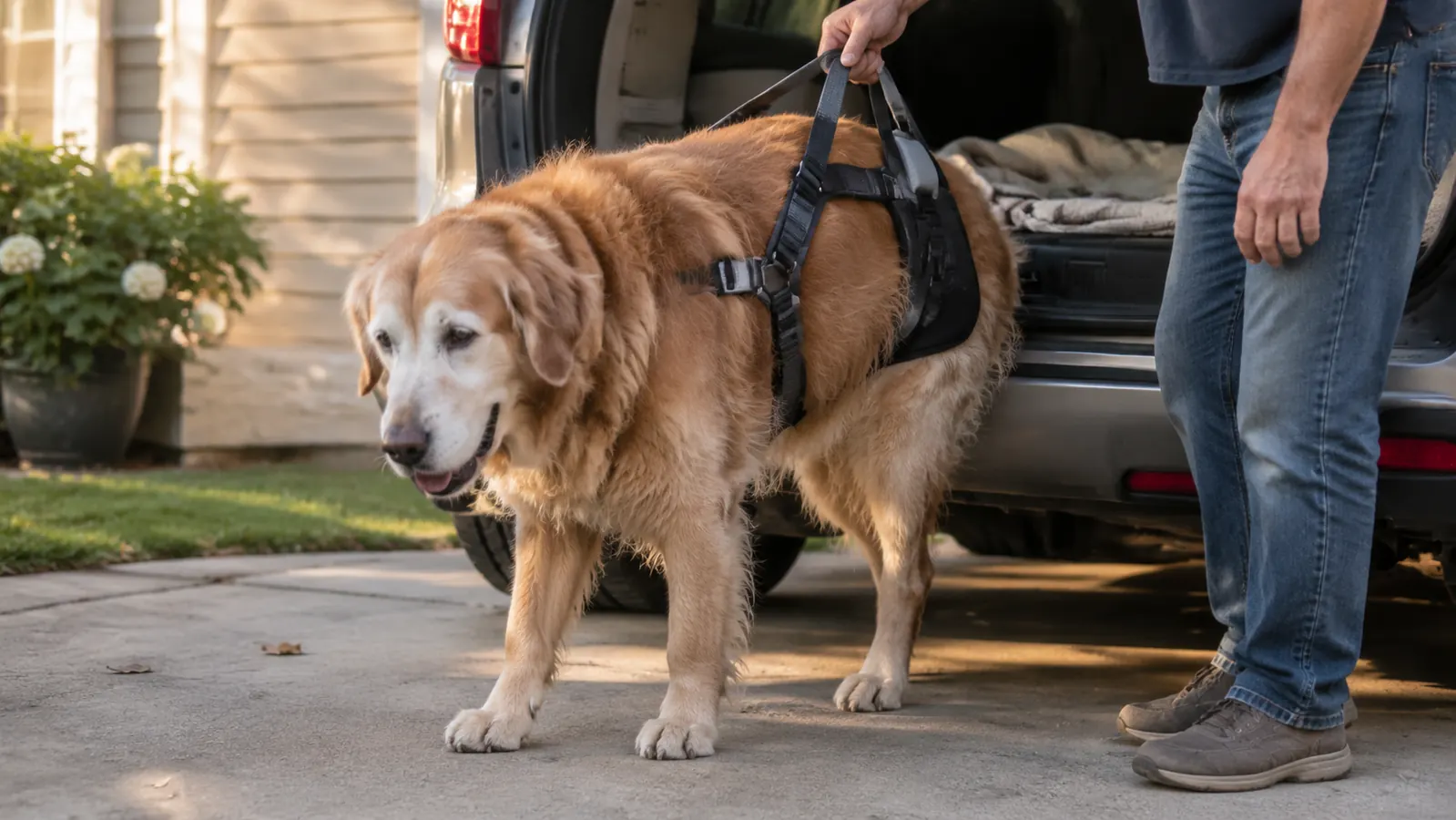
Here is the part that surprised me: the LOOBANI is not a full-body harness. It sits under the belly and around the hindquarters, and you hold the rear handle to take weight off the back legs. That means it does not restrict Rudy's front end at all. He walks, sniffs, and pees normally while I carry maybe a third of his weight from behind. For the back steps, I hold the handle lightly and let him do the work, just taking the edge off. For the car, I take a firmer grip and lift more, because that is the moment where his hips struggle most.
I keep it in a specific spot: a hook by the back door in summer, and in the car during the winter when we are running errands more often. It has become part of our routine the way the joint supplement has, not something I think hard about, just something I grab when Rudy needs a hand. On days when he is moving well, it stays on the hook. On bad days, it is in my hand before we open the door.
What the LOOBANI Actually Does
The product description calls it a hip sling, and that is the honest way to think about it. It is designed for elderly dogs, dogs with weak hind legs, and big breeds that need help standing, climbing stairs, getting into vehicles, or getting onto furniture. The key word is help. It does not replace the dog's legs. It supports them, and only for as long as you are holding the handle.
The features list mentions a thickening design and a soft lining with a sheepskin-like material, and after six months I can confirm the comfort part matters. The first cheap sling I tried years ago had a thin nylon strap that dug into the dog's belly and left a red mark after one trip down the steps. The LOOBANI spreads the support across a wider band, and Rudy has never once tried to wriggle out of it or acted like it hurt. That is the difference between a sling you actually use and one you leave in the drawer.
The drawstring closure is worth mentioning because it is the thing I was most skeptical about. I assumed I would be fighting with straps every time. In practice, you slide the sling under the dog, pull the drawstring snug around the belly, and the handle sits naturally over the rear. It takes me about twenty seconds to put it on, and Rudy stands still for it because he knows what comes next: the porch, the car, or the last few feet back from a walk.
How It Held Up Over Six Months
I am a person who keeps a notebook, and my notebook says we have used the LOOBANI on roughly 140 separate occasions: porch steps in the morning, car rides to the vet, the occasional single step into a friend's home. It has been rained on, dragged through mud, washed in the machine at least six times, and left crumpled in the bottom of the storage bag. It still looks and works the way it did on day one.
The nylon has not frayed. The stitching around the handle, which is the part I worried would fail first, is still tight. The drawstring has not stretched out of shape. The soft lining has flattened a little where it sits against Rudy's belly, but it has not worn through, and it has not made him sore. For a piece of gear that costs what this costs and gets used as hard as we use it, that is a solid result.
The one thing I would change is the handle itself. It is a sturdy nylon loop, which is exactly what you want for grip, but on a cold morning, or when Rudy is having a genuinely bad hip day and I need to take real weight, the handle digs into my hand a little. I solved it by wearing a gardening glove when I need extra grip. A little more cushioning there would be a genuine improvement. I also wish the storage bag had a clip so I could hang it on the hook with the harness inside, but that is a small thing.
The moment I knew the LOOBANI was working was the morning Rudy stood at the top of the back steps, looked at me, and waited for the handle instead of trying to decide whether he could make the jump.
The Tradeoffs Nobody Mentions
First, the LOOBANI is a helper, not a cure. If your dog's stiffness comes from arthritis or hip dysplasia, a sling will not change that diagnosis. It changes the mechanics of a specific moment. Rudy still needs his joint supplement every morning, he still takes the steps one at a time, and he still has days where he would rather nap than walk. The harness makes those days manageable. It does not make them disappear.
Second, it only helps when you are there to hold the handle. Rudy does not wear the LOOBANI around the house. He wears it for the thirty seconds it takes to get down the steps or into the car, and then it comes off. If you are looking for something your dog can wear all day, this is not that product. It is a tool for the moments when your dog needs a hand, and that means you have to be the hand. For us that is fine, because I am usually right there with him anyway, but it is worth being honest about before you buy.
Third, there is a learning curve for the human, not the dog. The first few times I used it, I gripped too hard and lifted too much, and Rudy actually stopped walking because he was not sure what was happening. You want to hold the handle with light, steady pressure and let the dog set the pace. Once I figured that out, it became second nature. I would recommend practicing on flat ground before you try the steps.
What I Liked
- Takes real weight off the hindquarters for steps, car rides, and standing up
- Simple drawstring design goes on in about twenty seconds with no buckles or straps to fight
- Soft lining and wide band are comfortable enough that Rudy stands still for it
- Machine washable and built to last; six months of heavy use and the stitching is still tight
- Comes with a storage bag, easy to keep in the car or by the door
- Light at about 14.88 ounces, so it is not another heavy thing to manage
Where It Falls Short
- The handle can dig into your hand on bad-hip days
- Only helps when you are there to hold the handle; it is not a wear-all-day harness
- Does not fix the underlying stiffness; it is a helper, not a treatment
- There is a short learning curve for the human to use light, steady pressure instead of over-lifting
Who This Is For
Buy the LOOBANI dog lift harness if you have a large or senior dog who is still strong up front but struggles behind. That is the profile it fits best. Rudy has good strength in his chest and shoulders, so he can climb the steps himself if I take just a little weight off his hips. A rear support sling is made for exactly that gap between 'my dog can still walk' and 'my dog cannot quite manage the hard moments alone.'
It is also a good fit if your dog needs help getting into the car, onto the couch, or up a single step, and you want something lighter and simpler than a full lifting harness. The LOOBANI folds into its storage bag and rides in the car without taking up space. For us, it has been the difference between leaving Rudy home on errand days and bringing him along, because I know I can get him in and out of the back seat without hurting either of us.
Who Should Skip It
Skip the LOOBANI if your dog cannot bear weight on the front legs at all. This sling supports the rear. It does nothing for a dog with weakness or injury in the front end, and in that situation you need a full-body lift or a cart, not a hip sling. Ask your vet before you buy if you are not sure which end is struggling, because the wrong tool will frustrate both of you.
Skip it if you are looking for something your dog can wear all day for support while walking. The LOOBANI is a moment-to-moment helper, not an orthotic. Rudy wears it for seconds at a time. If your dog needs continuous support, a rear-support walking harness with leg loops is a better category to explore, and that is a conversation worth having with your vet too.
And finally, if you are hoping a harness will replace the need for joint care, skip it. We use the LOOBANI alongside the joint supplement our vet recommended, not instead of it. The harness manages the hard moments. The daily routine manages the long game. Most of the senior dogs I know need both. I would not want anyone to read this and think a sling is the whole answer, because it is not. It is one good tool in a longer list of things that keep an older dog comfortable.
Six months in, this is the harness I grab first on Rudy's stiff days
The LOOBANI dog lift harness for large dogs is simple, comfortable, and machine washable, and it has made the back steps and the car door genuinely easier for us. If your big dog is slowing down behind, it is worth a conversation with your vet and a look at today's price.
Amazon Check Today's Price on Amazon →