
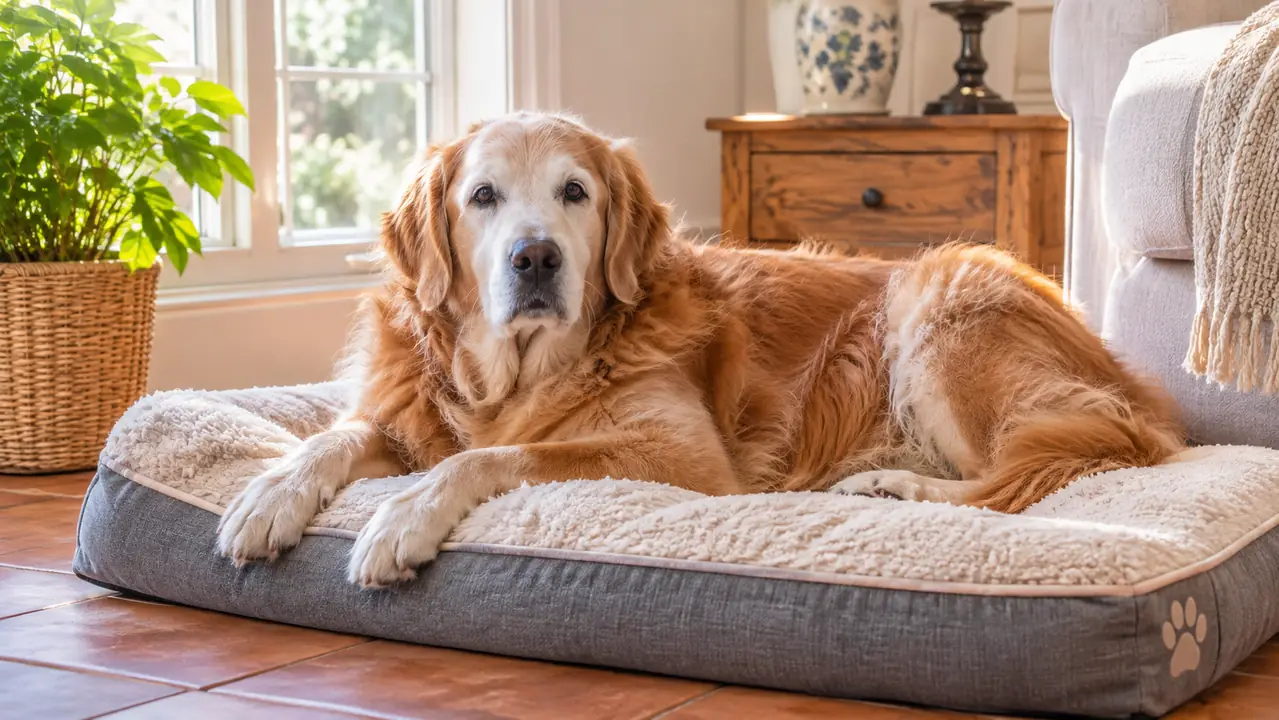
When Rudy hit about eight, I noticed he would stand at the edge of his bed for a long moment before climbing on. He is a 78-pound yellow Lab, and the flat bed he had slept on for years had packed down until it was basically a mat on the tile floor. Our vet said his back hips were stiff, and the tile floors in our single-story house were not helping. That is how I ended up in the pet aisle, staring at dozens of beds that all claimed to be orthopedic, with prices all over the map and no way to tell which one would actually help. I read reviews until my eyes crossed, and most of them could have been about any bed.
Here is what I learned: the word 'orthopedic' on a label does not mean much by itself. Some beds are orthopedic in name only, with a thin layer of foam over a hard base. Others are genuinely built for a heavy senior dog. After ten months of watching Rudy use the EHEYCIGA orthopedic bed we bought to replace the flattened one, I have a clear picture of what to look for, what to skip, and what to ask your vet before you spend the money. I am not a vet and I do not play one in this article. Everything below is what I learned from ten months of watching Rudy, plus what our vet told us when we asked about his hips. The short version: measure your dog, read the foam specs like you mean it, respect the weight limit, watch how your dog gets up, and plan for the messes. Here is each one.
The bed that finally held up to a 78-pound Lab
After ten months of daily use, the EHEYCIGA orthopedic bed is the one Rudy climbs onto first. Memory foam plus egg crate foam, three-sided bolsters, a waterproof layer, and a non-skid bottom. See today's price on Amazon and read the full review before you decide.
Amazon Check Today's Price on Amazon →Step 1: Measure Your Dog, Not the Room
The biggest mistake I almost made was picking a bed by eye. A large bed in the store looked enormous, but Rudy is 78 pounds and likes to stretch out. When he curls up he takes less space, but when he stretches he needs his full length plus room to shift. The EHEYCIGA bed we chose is 44 inches long and 32 inches wide, and it is the right size for him to sprawl with his legs out. If your dog is bigger, go up a size rather than hoping he will curl up tighter. A bed that looks generous in a photo can be surprisingly small next to a dog that takes up half the couch.
The way to check is simple: measure your dog from nose to the base of his tail while he is stretched out, then add six to eight inches. That is the minimum length the bed should have. Also measure the widest point of his chest. A bed that is too narrow means his legs hang off the edge, which defeats the purpose of pressure relief. A bed that is too short means his hips rest on the edge instead of on the foam.
One more thing about size: the bed has to fit the spot where your dog actually sleeps. Ours sits in the corner of the living room where Rudy can see Dale and me. If the only place for the bed is a hallway or a laundry room, your dog will choose the floor next to you over a bed in another room. Measure the corner, not just the dog, and remember that a 44 by 32 inch bed takes up a real footprint.
Step 2: Look for Real Foam, Not Just the Word 'Orthopedic'
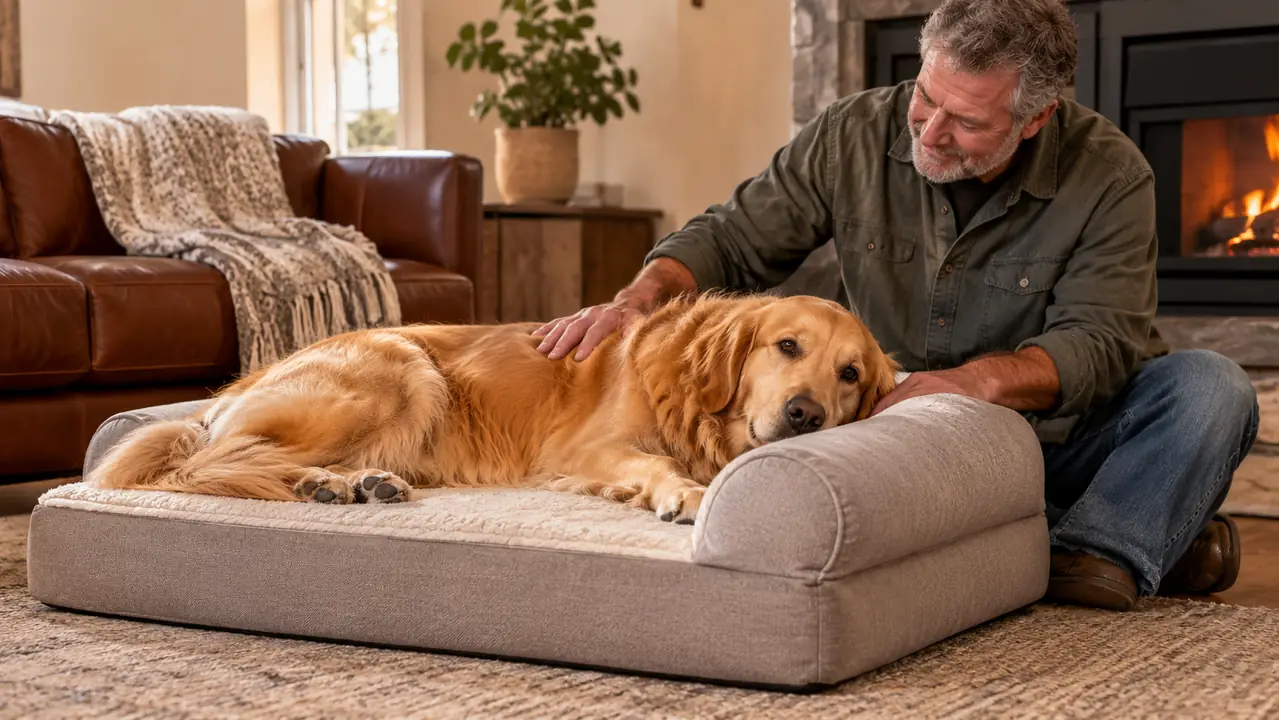
This is where the labels get slippery. A bed can be called orthopedic if it has any foam in it at all, even a thin layer. What matters is the construction. The EHEYCIGA bed uses memory foam plus egg crate foam. The memory foam molds to the dog's body, and the egg crate layer adds airflow and a little give. That combination is what spreads the weight of a heavy dog evenly across the surface. The word alone tells you nothing about how the bed will feel under a dog that weighs more than a child.
When you read listings, look for the foam layers to be named and the thickness to be stated. This bed is 6.5 inches thick, which sounds like a lot, and it is enough for a 78-pound dog to sink in slightly without bottoming out. A bed with only two or three inches of foam will flatten under a large dog in a matter of months. I know because that is exactly what happened to Rudy's old bed. It looked fine in the store and useless in the living room.
Also check how the foam recovers. Press a finger into the surface and it should spring back slowly, not stay dented. The memory foam in this bed still does that after ten months. If a bed shows a permanent dent after a few weeks, the foam is too soft for your dog's weight. That dent is where your dog's hip will sit every night, and it will not get better.
Step 3: Check the Weight Limit and the Base
The weight limit is the number people skip, and it is the number that matters most for a large dog. This bed lists a maximum weight recommendation of 100 pounds. Rudy is 78 pounds, so he is well within it. If your dog is close to or over the limit, the foam will compress faster and the bed will need replacing sooner. A weight limit is not a suggestion, it is a promise about how the foam will hold up. I have seen reviews from owners of dogs over the limit complaining the bed went flat in a month, and that tracks with how foam works.
The base matters too. A bed with a soft, sagging bottom lets the foam bend in the middle, which puts pressure on the hips instead of relieving it. The EHEYCIGA has a non-skid bottom, which I did not think I needed until I watched Rudy's old bed slide across the tile every time he climbed on. On tile, a non-skid bottom is not a luxury. It is the difference between a bed that stays put and a bed that ends up under the coffee table.
Lift the bed before you buy it if you can. This one weighs about 8 pounds, light enough to move for cleaning but heavy enough that the base has some structure. A bed that weighs almost nothing usually has almost nothing in it. The weight tells you there is foam in there, not just fabric and air.
Step 4: Think About How Your Dog Gets Up and Down
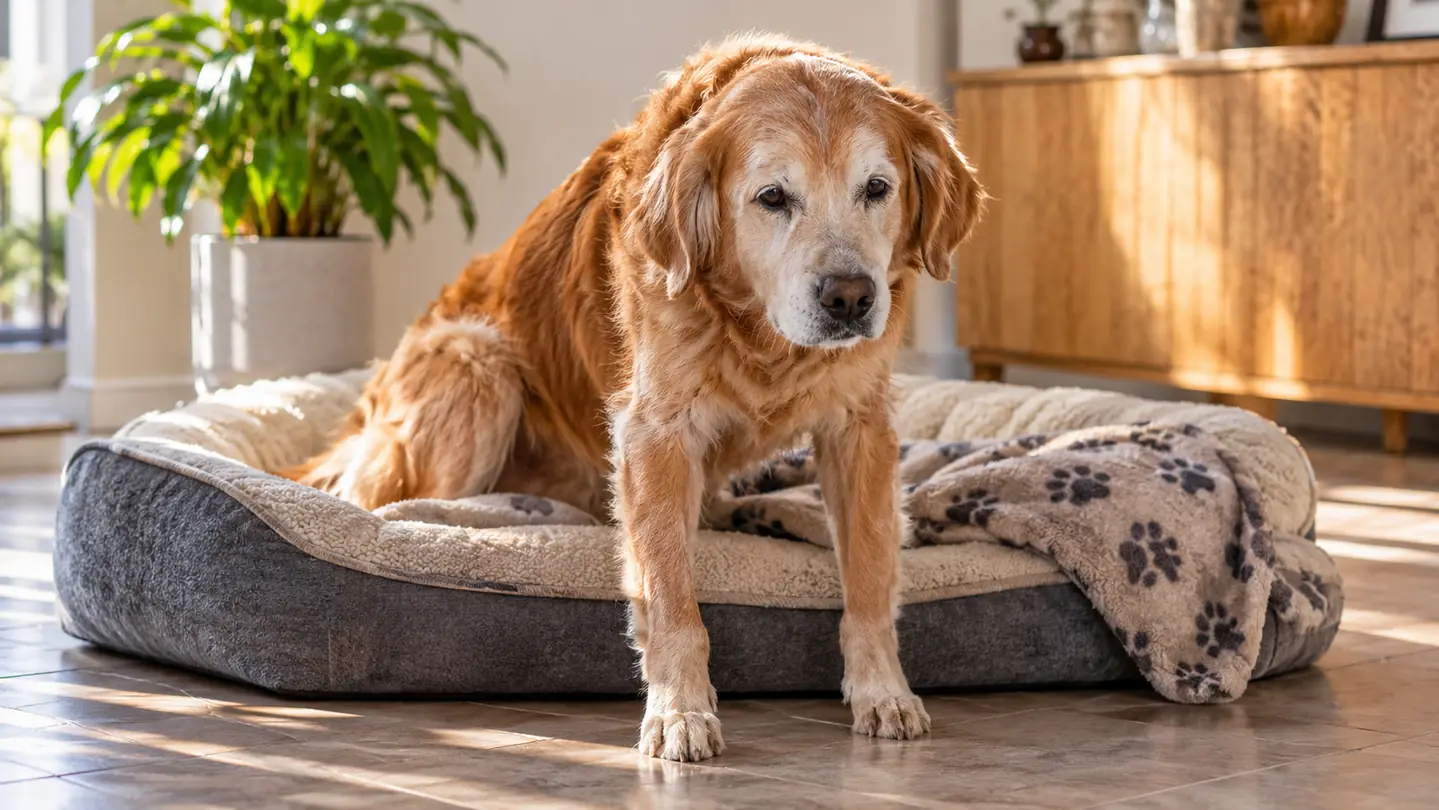
A senior dog does not get into bed the way a puppy does. Rudy stands at the edge, lowers his front end, then carefully folds his back legs under him. Getting up is harder: he rocks forward, pushes with his front legs, and needs a moment before his back hips cooperate. The height of the bed and the support at the edges matter for both motions. The edge of the bed is the part his hips hit first, so the edge has to give a little without collapsing.
This bed is 6.5 inches thick, low enough for Rudy to step onto without a ramp but high enough that he is not lying directly on the tile. The three-sided bolsters give him something to rest his head on and a slight barrier to lean against. I would not choose a very high bed for a stiff senior dog, because climbing up and down adds strain to the hips you are trying to protect. Keep the step low.
Watch how your dog positions himself. Rudy likes to rest his head on the bolster when he is awake and stretch out flat when he sleeps. The three-sided design gives him both options. A bed with bolsters on all four sides can feel like a box to a dog that likes to stretch, so think about your dog's sleeping style before you choose. If your dog likes to hang his head off the edge, a lower bolster or an open side matters more than you would think.
Step 5: Plan for the Waterproof Layer and Cleaning
The waterproof part sounds like it is for puppies, but it is really for senior dogs. Older dogs have accidents, especially on cold mornings or when their hips make it hard to get outside in time. The EHEYCIGA has a waterproof film between the fleece surface and the bottom fabric, so liquid does not soak into the foam. That is the difference between wiping a surface and throwing away a bed.
Check how the cover attaches before you buy. A zippered, removable cover is the easiest to wash. This bed is listed as easy to clean, and the fleece surface wipes down well for small messes. For deeper cleaning, you want a cover that comes off without a fight. I have washed the cover on ours and it has held up fine, which matters when you are washing it more often than you expected. The cover is the part that takes the abuse, so it has to be the part you can actually clean.
One note on the foam itself: it arrives compressed in the box and needs 24 to 48 hours to expand fully. Do not judge the bed in the first hour. Put it where your dog sleeps, let it puff up overnight, and let your dog discover it on his own. Rudy was suspicious for about a day, then claimed it as his. Give the bed the full two days before you decide it is too firm or too soft.
What Else Helps
A good bed is one piece of the puzzle, not the whole answer. For Rudy, the combination that works is the bed for rest, a lift harness for the porch steps and the car, and the joint supplements our vet recommended, which he has been on for about two years. I noticed easier get-ups after roughly six weeks on those, and the bed made the mornings more comfortable from the first night. None of it was a quick fix, and none of it replaced a checkup. The harness came later, after a morning when Rudy hesitated at the top of the porch steps and I realized he needed help on the way down, not just the way up.
Talk to your vet before you buy anything, including a bed. Our vet reminded me that a dog that suddenly cannot get comfortable, or that avoids the bed entirely, might be in more pain than usual and needs a checkup, not just a new mattress. The bed is comfort. The vet is medicine. Both have a job to do, and they work better together.
If your dog is already on joint supplements, keep the bed question separate from the supplement question. The bed does not replace the chewable tablets or the fish oil our vet suggested. It makes the hours between doses more comfortable. If your dog is not on anything yet, ask your vet about that too, but do not let the bed wait. A senior dog spends a lot of hours lying down, and those hours count.
Ten months in, the EHEYCIGA bed still springs back when Rudy climbs off, and his morning get-ups are easier than they ever were on the flat bed.
Give your senior dog a bed that actually supports his hips
The EHEYCIGA orthopedic bed held up to ten months of daily use by a 78-pound Lab with stiff hips. Memory foam and egg crate foam, three-sided bolsters, a waterproof layer, and a non-skid bottom. Check today's price on Amazon, and ask your vet if it is right for your dog.
Amazon Check Today's Price on Amazon →