
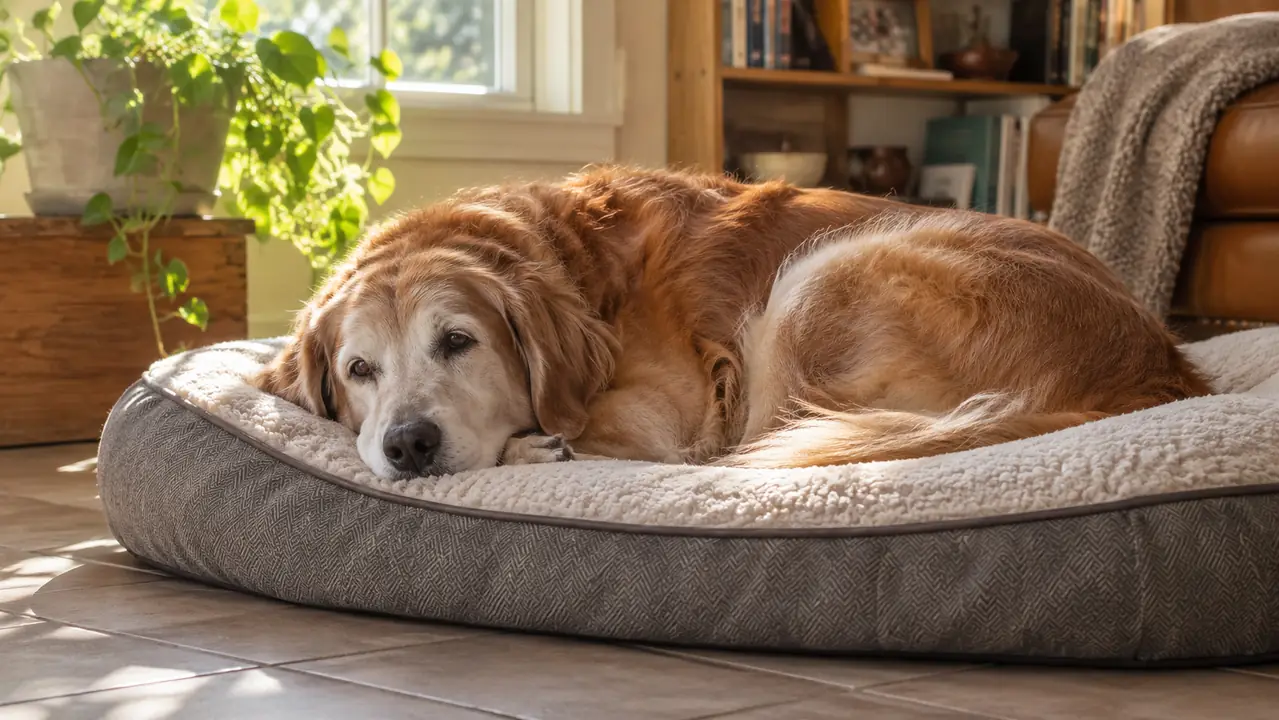
When Rudy turned nine, I started watching him do that slow, careful stand-up after a nap. He is a 78-pound yellow Lab, and our house in Ormond Beach is all tile floors. A dog that size does not get up gracefully off a flat bed on tile. He would rock forward, brace, and take a breath before his back legs decided to cooperate. I had already talked to our vet about his hips, and Cosequin is part of his daily routine. But rest is the other half of the joint story, and the flat bed he had been sleeping on was doing him no favors.
So about ten months ago I bought the EHEYCIGA orthopedic dog bed in the extra large size. I did not tell Rudy it was for his joints. I just put it where his old bed had been and watched what he did with it. This review is what I wrote down in my notebook over those ten months.
The Quick Verdict
A thick, supportive memory foam bed that gives a big senior dog a stable place to rest and an easier time standing up. Not a cure for arthritis, and it needs a few days to fully expand, but it is the best rest setup I have found for Rudy.
Amazon Check Today's Price →Give Your Senior Dog a Better Place to Rest
The EHEYCIGA orthopedic memory foam bed is the one Rudy has slept on every night for ten months. Check today's price on Amazon and see if it is the right fit for your dog's size.
Amazon Check Today's Price on Amazon →How I've Used It
Rudy has slept on this EHEYCIGA bed every night since I set it up. During the day he naps on it too, usually with his head resting on one of the raised sides. I have watched him use it in every position a 78-pound Lab can manage: curled up, stretched out, and flopped on his side with his legs against the edge.
The bed is 44 inches long, 32 inches wide, and 6.5 inches thick, and the EHEYCIGA listing recommends it for extra large dogs up to 100 pounds. Rudy is 78 pounds and he has room to stretch. The raised bolsters on three sides give him somewhere to rest his head, which he uses more than I expected. He has always been a dog who likes his head on something, and the 3-sided design is the reason this bed replaced the flat one.
The first night, Rudy treated it like a stranger. He walked around it twice, sniffed the edge, and then stepped on with one front paw as if he were testing ice. I stood in the hallway and watched him turn a slow circle before he folded himself down, and I will admit I held my breath. By the end of that first week he was putting himself to bed on it before I turned off the lights, which is about as strong a review as a dog can give. He uses it differently depending on the day. On cool mornings he curls into the corner where two of the bolsters meet, with his nose tucked under his tail. On warm afternoons he stretches out flat with his back legs hanging over the edge. I have started reading those positions as a sign that he is comfortable, and for a dog who spent two years flattening a cheaper bed, that is not a small thing. The only time he does not sleep on it is when the weather turns hot enough that he prefers the bare tile, and even then he is back on the bed by evening.
The other thing I did was give it time. The EHEYCIGA instructions say to let the bed expand for 24 to 48 hours after unpacking, and that is not a suggestion. When I first opened the box it looked flat and I worried I had made a mistake. By the second morning it had puffed up to its full thickness, and by day three it felt like a different bed entirely. If you buy one, unpack it and wait before you judge it.
What the Memory Foam Actually Does
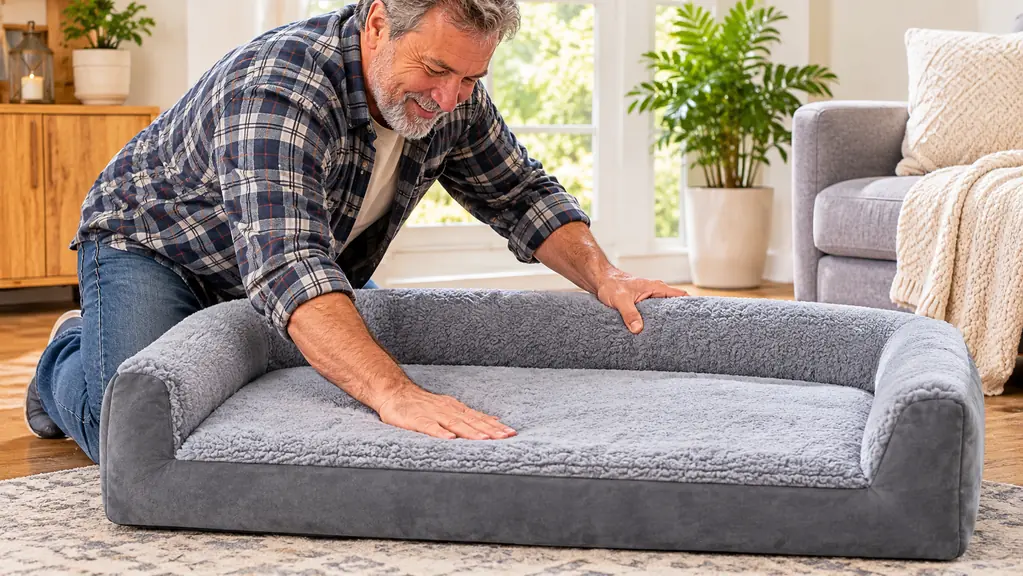
The EHEYCIGA bed uses two layers: memory foam and egg crate foam. The memory foam is the top layer that molds around a dog's body, and the egg crate foam underneath adds airflow and a little bounce. Together they spread Rudy's weight evenly instead of letting his hips and elbows press into a hard floor.
I can feel the difference when I press my hand into it. The surface gives slowly and springs back. When Rudy lies down, he sinks in just enough that his shoulder and hip are supported instead of bearing his full weight on a thin pad. For a dog with stiff hips, that even support is the whole point. He is not sleeping on a harder surface underneath the bed; he is sleeping on the foam itself.
I can tell you exactly what it replaced, because I kept the old bed in the garage for a month before I threw it out. It was a flat mat with maybe an inch of padding, and two years of a 78-pound dog had packed the filling down until it was barely thicker than a rug. When Rudy lay on it, I could see his hip bone pressing against the surface. That is the comparison that matters. This bed is 6.5 inches thick at the center, and even with Rudy's full weight on it, the foam holds its shape. I measured it once out of curiosity, with him lying on it, and the surface still sat a good four inches off the floor. He is not bottoming out. That is the difference between a bed that supports a heavy dog and a bed that only looks like it should. The egg crate layer underneath is the part you cannot see, but it is the reason the memory foam does not turn into a warm, flat pancake by the end of the night.
What it is not is a cure. Our vet has been clear with me: no bed fixes arthritis, and I am not going to tell you this one does. What a good orthopedic bed does is make rest easier and take pressure off sore joints while a dog sleeps. That is what I have watched it do. Rudy still has stiff mornings sometimes, especially when the weather changes, but he gets up from this bed more easily than he did from the flat one.
Rudy still has stiff mornings sometimes, but he gets up from this bed more easily than he did from the flat one.
Ten Months of Mornings
The change I noticed was not dramatic and it did not happen overnight. It was a slow, steady difference in how Rudy stood up. With the old flat bed, he would rock and brace before his back legs engaged. On the EHEYCIGA bed, he still takes a moment, but he does not brace the same way. He pushes up from a more stable surface and his feet do not slide on the tile the way they used to.
The non-skid bottom matters more than I expected. Our floors are tile, and Rudy's old bed would drift a few inches across the room as he moved around on it. The EHEYCIGA bed stays put. The bottom grips the tile, so when Rudy steps off the bed he is stepping onto solid ground instead of a bed that slides under him.
I also want to be honest about the waterproof layer. The EHEYCIGA bed has a waterproof film between the fleece surface and the bottom fabric, which means accidents do not soak through to the foam. We have not had a major accident, but Rudy is an older dog and I like knowing the foam is protected. The cover itself is easy to clean, which matters when you share a house with a drooly Lab.
One thing to know: the bed takes a little maintenance. The cover is removable and washable, and I wash it every couple of weeks. The foam base itself is not something you toss in the washing machine. I spot clean it and let it air out. That is a fair trade for a bed that has held up for ten months without going flat.
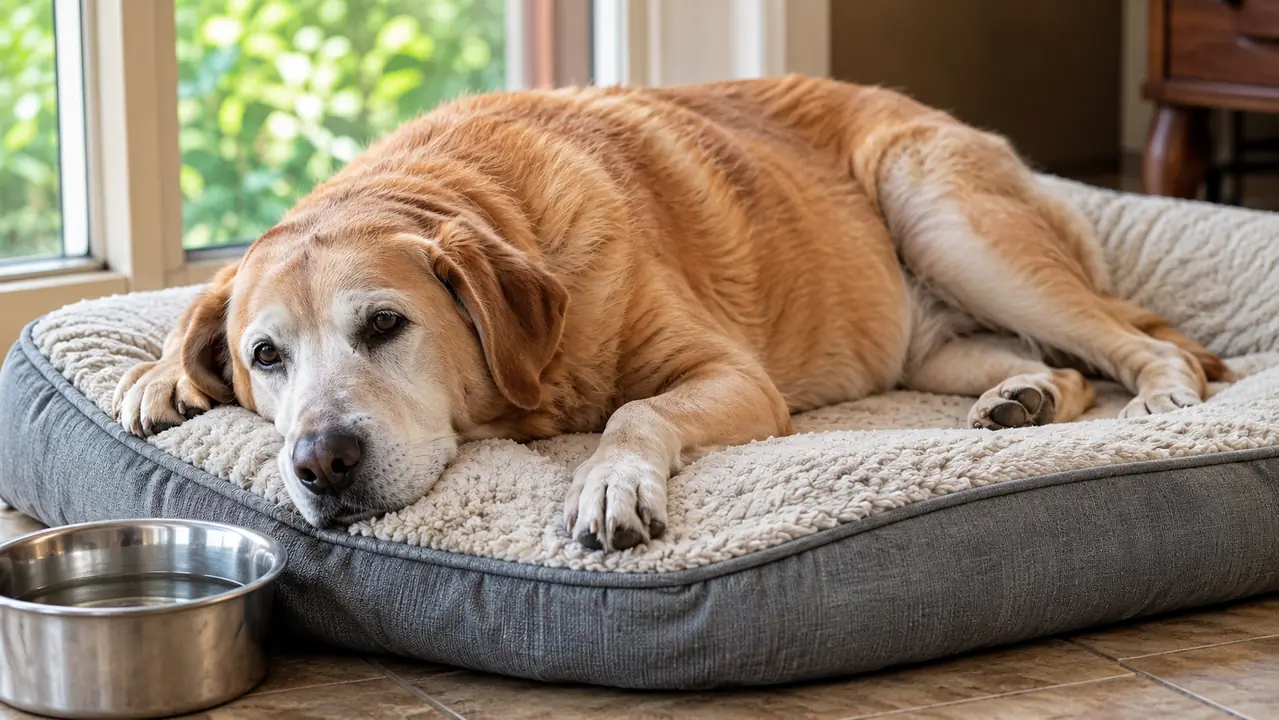
I keep a notebook, so I can give you one concrete morning. This past February we had a stretch of damp cold, the kind that makes Rudy's hips worse, and he had been stiff for three days straight. I went to let him out expecting the slow, painful get-up he had been doing all week. Instead he pushed himself up on the first try. Not quickly, and he stood still for a few seconds before he walked, but he did not brace. I wrote 'first try' in the notebook and circled it. One morning does not prove anything by itself, and I am not going to tell you this bed fixed his hips. But that morning happened, and it is the reason the bed is still in our living room ten months later. I have watched him stand up from this bed more times than I can count, and the pattern is consistent: easier in the morning, steadier on his feet, less sliding on the tile.
The Tradeoffs Nobody Mentions
The biggest tradeoff is size. This is an extra large bed, 44 by 32 inches, and it takes up real floor space. In our living room it sits against the wall and it is the largest dog bed we have ever owned. If you have a small apartment or a dog under 50 pounds, this size is probably more than you need.
The second tradeoff is the expansion time. The bed arrives vacuum-packed and flat, and it needs 24 to 48 hours to reach its full shape. If you are buying this because your dog is recovering from surgery and needs a good bed tonight, plan ahead. The first night it will be thinner than it will be a week later.
The third thing is that Rudy is a chewer, but only sometimes. He has never chewed this bed, and I think the fleece surface does not interest him the way a loose corner might. Still, if you have a dog who chews beds, no bed is chew-proof. Watch the first few days and see how your dog treats it.
There is also the question of where the bed ends up living. Because it is 44 inches long and 32 inches wide, it does not tuck neatly under a window or beside a door. It becomes a piece of furniture. In our house, that meant rearranging the corner of the living room so the bed could sit against the wall without blocking the path to the kitchen. I mention this because it is the kind of thing you do not think about when you are reading a listing on your phone. You think about your dog, and then the box arrives and you realize you are also making room for a 44-inch piece of foam. It was worth it for us, and I would buy it again, but I want you to measure your space before you order, not after. The listing gives the dimensions for a reason. A bed this size needs a wall and a corner, and if your house does not have one, you will be tripping over it by the second week.
What I Liked
- Thick memory foam and egg crate layers spread a heavy dog's weight evenly
- 3-sided bolsters give a big dog somewhere to rest his head
- Waterproof film between the surface and the bottom protects the foam
- Non-skid bottom stays put on tile floors
- Held up for ten months of nightly use without going flat
- Removable, washable cover makes cleaning straightforward
Where It Falls Short
- Large footprint takes up real floor space
- Needs 24 to 48 hours to fully expand after unpacking
- Foam base is spot clean only, not machine washable
- Not a cure for arthritis, and no bed is
Who This Is For
This EHEYCIGA bed is for owners of large and extra large dogs who want their dog to rest on something with actual support. If your dog is over 60 pounds, sleeps on the floor or on a flattened bed, and takes a moment to stand up in the morning, this is the kind of bed worth trying. The memory foam and egg crate layers are designed for even support and pressure relief, which is exactly what a heavy dog needs.
It is also for people who are tired of washing a bed every other day. The waterproof layer and removable cover make this the easiest large dog bed I have owned to keep clean. And if your dog likes to rest his head on something, the 3-sided bolster design is a feature you will appreciate every single night.
Who Should Skip It
Skip this bed if you have a small dog or a dog under 50 pounds. The extra large size will swallow a small dog and take up more room than it needs to. There are smaller EHEYCIGA sizes that make more sense for a smaller dog.
Skip it if you need a bed today and cannot wait 24 to 48 hours for it to expand. The bed arrives flat and needs time to reach its full thickness. And if your dog is a determined bed chewer, no foam bed is safe, so you will want to supervise the first few days before trusting it.
Most importantly, talk to your vet before you assume a bed will solve a mobility problem. If your dog is struggling to stand up, slowing down, or hesitating on stairs, the bed is a comfort, not a treatment. Our vet is the reason Rudy is on the joint supplements he takes, and the bed works alongside that plan. It does not replace it.
A Bed That Earned Its Spot in Our Living Room
Ten months in, the EHEYCIGA orthopedic memory foam bed is still the first place Rudy goes when he wants to nap. If your big dog needs a better place to rest, check today's price on Amazon.
Amazon Check Today's Price on Amazon →